Saturday, November 5, 2011

Thinking about writing

My previous post came out of an evening of frustration while copy editing. But I must acknowledge that most of what I was editing was written in just a few hours, if that. The unfortunate nature of the small newspaper business is that writers don't have much time to think about their stories before they have to move on to the next thing.
I would hope, if the reporters had the time, that they would have gone back and fine-tuned what they had written.

My frustrated observations are nothing new. Many writers more experienced than I am have already commented on the matter:

"The difference between the almost right word and the right word is really a large matter - 'tis the difference between the lightning bug and the lightning."
- Mark Twain.

(Editor's note: Forgive Mr. Clemens this use of "'tis.")

‎"Writing is nature's way of letting us see how sloppy our thinking is."
- Richard Guindon
Apparently, this was the caption of one of Mr. Guindon's cartoons. I wish I could find the cartoon.


"What is written without effort is in general read without pleasure."
- Samuel Johnson


"The best part of all, the absolutely most delicious part, is finishing it and
then doing it over."
- Toni Morrison.


Yes, we writers are afflicted with a modicum of masochistic madness.

Tuesday, November 1, 2011

Avoid sounding like everyone else or even yourself

Words and their meanings have perplexed and fascinated me for most of my life.
So many wonderful words exist that it seems a shame not to sample as many as possible. But sometimes, to really get your meaning across, only one will do.
Writers should make it their quest to employ the right words. Even though the thesaurus may list 10 lines of synonyms, Catherine Soanes demonstrates that rarely can you substitute one word for another and have it convey the same meaning.
True, if your reader isn't familiar with such nuances, substituted words might not make any difference... or the reader may get the wrong idea no matter what word you use. But you are not writing for them.
Writers are often tempted to find something different to spice up their copy after they've had to repeat a word, no matter how right. If so, they should at least make the effort to find the next best word.
I guess that's why #TheOldEditor says "Giving a reporter a thesaurus is like giving a toddler a loaded handgun."

Think about the words you use and why you choose them. One writer I work with uses certain words in almost every story; I guess they're supposed to be part of the writer's voice. But if I never read the words "folks," "critter," or "first ever" in a news story again, it will be too soon. "Fire folks" is probably not a good substitution for "fire crew."
But I don't think the writer is thinking about the words themselves. Perhaps they are just thinking about what might sound cool.
Or we get into habits.
I almost wrote the first sentence of this post like this: "Words and their meanings have perplexed and fascinated me all my life." But has it really been "all my life?" Did I come out of the womb contemplating the difference between "your" and "you're?"
No, it's just the kind of thing people say.
Whenever superlatives or extreme words like "always," "never," "all" or "none" pass from your keyboard to the computer screen, you should stop and ask, "Is that really so?"

Some writers might try to up the coolness factor by throwing in some line -- metaphor or phrase -- that they've read elsewhere. Writers throw in terms like "that's a sticky wicket" or "that begs the question" because they've heard others use them. But some meanings aren't intuitive, and the phrases are sometimes used the wrong way (The photo shows a sticky wicket -- a muddy cricket pitch -- at the North Perrott Cricket Club). Just as it's sometimes enlightening to look up the meaning of a common word (I am still occasionally surprised), writers should make sure they understand phrases before they use them.
Other times, writers recycle tired metaphors, which can hinder their efforts to come up with original ideas, something my teachers favored ("Avoid cliches" is tattooed on my left hemispheric cortex, not that I've always heeded it).

Originality is a key part of being a good writer and it applies to both word usage and ideas. But creating an original idea is challenging because so many types of stories have already been written.

Talk about challenging: Anyone who has had to write a holiday story knows what a struggle it can be to avoid the trite, the sappy and the cliche'. The temptation elves are everywhere, which is why the editor of the Baltimore Sun has put out a warning to stay away from the snow-borne sirens that have seduced many a writer: forced riffs on holiday phrases, such as "white stuff," "Bah, humbug," "T'is" and "T'was."

Every writer wants to produce engaging prose. But while you're trying to make those enlightened words flow onto the page, check your word and phrase choices now and then. Then go back through and ask yourself if anything else might work better.

Wednesday, October 26, 2011


Here is the link to Cheryl's updated presentation on web research. Thanks again to Cheryl from The Seattle Times for sharing her considerable knowledge about where to find information on the internet.

I set this up in Google Docs. When you click on the image above it should open in PowerPoint. Go to the upper right corner and click on "Start Presentation" for the slides to show. When I tried it, the links to the various sites were live.

Let me know if you have trouble seeing the presentation.

Thursday, October 20, 2011

Some can get away with it

A few posts ago, Larry Cheek provided a list of what to do (or not) when dealing with editors. He said, "An essay, being much about your voice, your experience, and your interpretation, is basically the writer's property."

Apparently, that's what David Foster Wallace believed too, because in 1998, along with an essay on Kafka, he sent a letter to the editors of Harper's Magazine, basically demanding that they keep their red pens in their pockets.

If they touched his essay, he promised to "find a way to harm you or cause you suffering* if you fuck with the mechanics of this piece."

I don't know that this is in keeping with Cheek's other recommendation to "cultivate a personal relationship."

Friday, October 14, 2011

Introductions

On many Internet forums, moderators ask that newcomers introduce themselves to the group. So...
My name is Laura L. (as opposed to Laura G.), and John B. Saul was my professor in Fall 2008 when I was a student in the School of Journalism at the University of Montana.
He took on the Herculean task of beating my boring, boorish and backward copy into something more bearable. Three years later, I am still trying to improve my writing - an undertaking that is
never-ending and now more difficult without such a guiding hand.
But I enjoy the process, and if it takes a lifetime of trial-and-error to become fractionally better, there are worse ways to spend a lifetime.

Now that the introductions are out of the way, I would turn your thoughts to paraphrasing.
Every writer has to try to condense a source's comments to write a compelling story. The use of too many direct quotes can slow the pace of prose.
But writers must use caution when paraphrasing, because if key details are lost, so is the intended meaning.

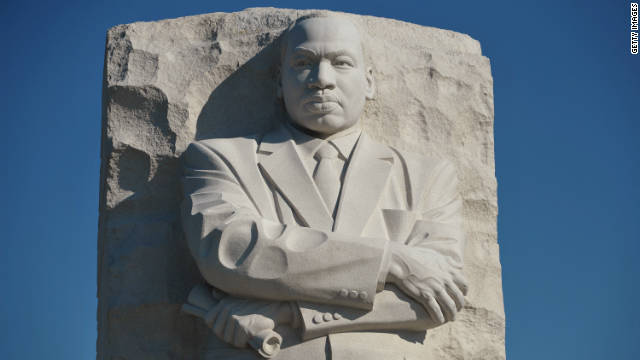
Case and point: the inscription that is now on the sculpture at the new Martin Luther King Jr. National Memorial. The inscription paraphrases part of one of King's speeches, but Roy Peter Clark and others argue the paraphrase is inaccurate. Unfortunately, now it is literally carved in stone.
King's time was recent enough tha
t people are still familiar with his speeches, and some know better than to trust the inscription. But as time goes by, that could be less the case, especially considering how often incorrect information is perpetuated on the Internet.
So i
f a writer wants a story to be accurate - every nonfiction writer should want that - pay particular attention to paraphrasing. The treasury of history depends on veracious retelling.
The blog that refuses to die

Former students (and fellow teacher Larry):

I have maintained a WRI-TING blog since 2007 while teaching at two universities. Now the school I am teaching at requests that we use its software product instead of outside sources. I'm doing that, but I could not stand to see our blog die. So I have renamed it and re-purposed it.

From now on, consider this a place to share thoughts, books, websites, other blogs and anything else that has to do with writing. The contributor list will be open to anyone who has taken a reporting or writing class from me.

Let me know if you want to be added as a  contributor. If you just want to look in on us once and a while, feel free to do that. There are only 100 spots on the contributor list, so if you join as a contributor, please contribute. And mind your manners.

Larry and I added last year's class as authors. If you are one of those people and want to be removed, let me know.

John B.
Feel free to add to this list

Mantra asked me for a list of "must read" non-fiction books, something I had never thought of. I suppose someone has compiled one somewhere but I have not. I can share some suggestions from last year's class. I have read most of them and found them worth my while:

"Our Guys" by Bernard Lefkowitz
"Methland: The Life and Death of a Small American Town" by Nick Reding
"The Red Parts: A Memoir" by Maggie Nelson

We had at least two people in class last year writing about murder cases, so some of the suggestions tended to be on the grisly side.

Also recommend but still on my "to read" list:
"At Large and At Small: Familiar Essays" by Anne Fadiman

Here's a book that William Dietrich said he read as part of his research for "Blood of the Reich," the novel you can read for this class (or if you prefer to read some of Bill's non-fiction work, I recommend "The Northwest Passage," his book on the Columbia River): "Himmler's Crusade: The Nazi Expedition to Find the Origin of the Aryan Race." That would be a good one to read before Bill visits the class.

Here are the non-fiction book I have read in the past year that I think are worth consideration:

"The Innocent Man: Murder and Injustice in a Small Town" by John Grisham (famous novelist tries out non-fiction, successfully, I thought)
"North by Northwestern: A Seafaring Family on Deadly Alaskan Waters" by Capt. Sigg Hansen and Mark Sundeen (I didn't expect to like this one, but it tells a lot about Seattle and its connection to the fishing industry.)

I highly recommend two books by Ahmed Rashid, a Pakistani journalist: "The Taliban" and "Descent into Chaos"
"The Lexicographer's Dilemma" by Jack Lynch is a fascinating book on the English language and the development of grammatical rules.
Bill Bryson brings humor and his own personality into his non-fiction: "Notes from a Small Island" is about living and traveling in England.

"At Home" by Bryson was recommended by the class last year but I have not read it.